What to Look For in a Firearms Training Course
Whether you need a course for a permit application or simply want to improve, here is how to judge instructors, curricula and class formats.

For many people, a firearms course is the first formal step toward carrying. Some take one because their state requires training for a permit. Others want to build confidence before carrying, or to improve skills they already have. Whatever the reason, courses vary enormously in quality, format and focus. A little research before you sign up helps you get real value for your time and money.
Start with your goal
Be clear about what you need:
- Permit requirement. If you need training for a permit, your first question is which courses your state accepts. Requirements vary: some states specify classroom hours, some require a live-fire qualification, some accept certain online or classroom-only formats, and some have no training requirement at all. Check your issuing agency’s current guidance before you enroll, and keep any certificate in a safe place.
- Foundations. If you are new, look for a course built around safety, handling and marksmanship fundamentals.
- Skill building. If you are experienced, look for courses in specific areas such as drawing from concealment, low-light skills or decision-making.
Evaluate the instructor
The instructor matters more than any other factor. Questions worth asking:
- Credentials. What certifications does the instructor hold, and from which organizations? Is the instructor recognized by your state for permit training, if that applies?
- Experience teaching. Being a skilled shooter and being a skilled teacher are different things. How long have they taught students at your level?
- Teaching style. Do reviews and word of mouth describe them as patient and clear? The best instructors build confidence rather than intimidate.
- Emphasis on safety and law. A good instructor stresses safe handling constantly and treats legal topics carefully, noting that laws vary and change and encouraging students to verify current rules.
Look at the curriculum
Ask for a course outline. A solid introductory curriculum commonly covers:
- The universal safety rules and safe handling.
- How handguns and ammunition function, and how to safely load, unload and clear common malfunctions.
- Marksmanship fundamentals: grip, stance, sight alignment and trigger control.
- Safe storage at home and in vehicles.
- An overview of the legal framework for carrying and the use of force in your state, presented as general education rather than individual legal advice.
- Avoidance, awareness and de-escalation.
Be wary of courses that focus heavily on bravado or worst-case scenarios while giving little time to safety, law and judgment.
Consider the format
Classroom and online instruction
Classroom and online formats work well for safety rules, legal overviews, storage and decision-making concepts. They are convenient and can be revisited. Some states accept certain online courses for permit purposes, while others require in-person instruction or a live-fire component. Verify what your state accepts before relying on any format.
Live-fire range instruction
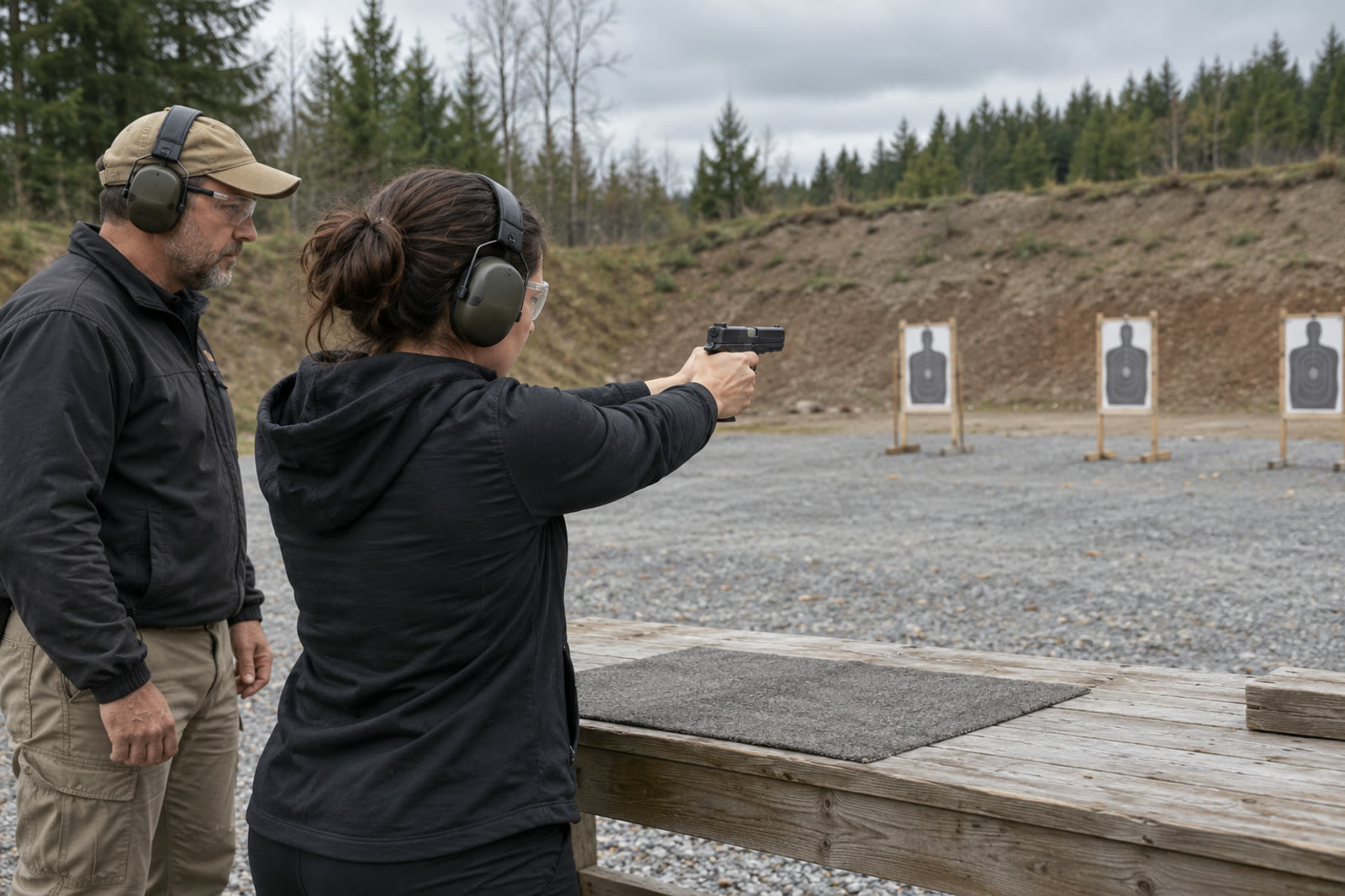
Hands-on instruction lets an instructor observe and correct your technique. Even if your state does not require it, many people find a live-fire session with a qualified instructor to be the single most valuable part of their training.
Blended courses
Many programs combine both: classroom or online material followed by range time. This can be an efficient way to cover knowledge and skills thoroughly.
Practical details to check
- Class size and instructor ratio on the range. Smaller ratios mean more individual attention.
- Equipment. What should you bring? Are rental handguns, eye protection and hearing protection available?
- Ammunition requirements and whether they are included in the fee.
- Range rules and safety briefing. A good course begins with a clear safety briefing and an emergency plan.
- Total cost, including range fees, ammunition and any certificate fees.
- Documentation. If you need proof of training for a permit, confirm the certificate includes everything your issuing agency requires.
Warning signs worth noticing
Most instructors are conscientious professionals, but it pays to know what a poor course can look like. Be cautious if you notice any of the following:
- Lax safety. Muzzles pointed carelessly, fingers on triggers, or no clear range commands. Safety should be visible from the first minute.
- Overconfident legal claims. Statements such as “you can always” or “the law says” without qualification. Good instructors explain general principles, acknowledge that laws vary and change, and send students to official sources.
- Promises about outcomes. No course can promise that a permit will be issued. That decision belongs to the issuing authority.
- Unclear paperwork. If you need the course for a permit and the provider cannot tell you how its certificate meets your state’s requirements, keep looking.
- Intimidation. Mocking beginners or encouraging aggressive attitudes has no place in responsible training.
If something feels wrong during a class, you are entitled to step back and ask questions, or to leave.
After the course
Treat a course as a beginning. Ask the instructor what you should practice, write it down and build it into a regular routine. Consider planning your next course before the current one fades from memory. And keep your notes and certificate somewhere safe: you may need them for renewals or future applications.
Key takeaways
- If you need training for a permit, confirm which courses and formats your state accepts.
- Choose instructors for teaching skill, credentials and a strong emphasis on safety and law.
- Look for a balanced curriculum: safety, fundamentals, storage, legal overview and avoidance.
- Treat every course as a beginning, and keep your certificate safe.
This article is general information, not legal advice. Laws vary by state and change over time, so check your state’s current rules with the appropriate official sources, and consult a qualified attorney about your specific situation. Home Guard Journal may receive compensation from partners featured on this site; see our Advertising Disclosure.